
Loading...
Loading...
Damage multipliers this Pokemon takes from each attacking type (based on the current form).
Damage multipliers of this Pokemon's same-type (STAB) moves against each defending type.
 Gardevoir-MegaPsychicFairy6.6%
 RillaboomGrass5.4%
 IndeedeePsychicNormal4.8%
 Absol-Mega-ZDarkGhost4.3%
 PolitoedWater4.2%
 IncineroarFireDark4.2%
 ArchaludonSteelDragon4.1%
 Psychic SeedHeld: Consumed on Psychic Terrain and raises the holder’s Special Defense by one stage.51.1%
 Grassy SeedHeld: Consumed on Grassy Terrain and raises the holder’s Defense by one stage.25.6%
 Electric SeedHeld: Consumed on Electric Terrain and raises the holder’s Defense by one stage.19.1%
 White HerbHeld: Resets all lowered stats to normal at end of turn. Consumed after use.2.8%
 Wide LensHeld: Provides a 1/10 (10%) boost in accuracy to the holder.0.3%
High-firepower meta Pokémon that hit it super-effectively by type (estimated, not battle data)
 Baxcalibur×2
 Hatterene×2
 Alakazam×2
 Salamence×2
 Metagross×2
 Dragonite×2
Based on real ladder matchup statistics and expert community assessments (data snapshot 2026-08)

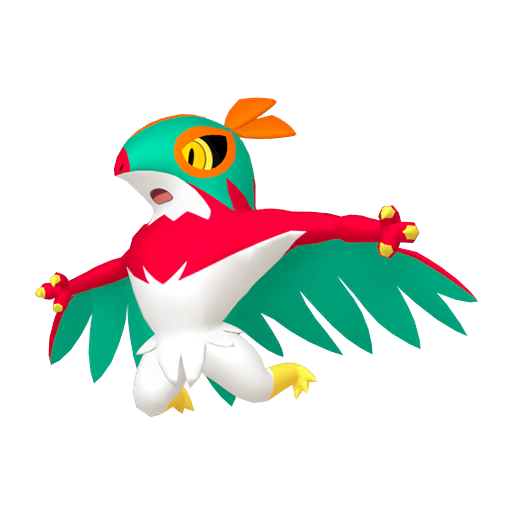
Hawlucha sits at 0.15% usage and rank 147 in M-A singles, firmly in the niche tier. Unburden lets it convert a consumed item or a successful Swords Dance into outspeeding nearly the entire metagame, and its dual STAB coverage gives it real KO power once boosted. Ground immunity and resistances to Fighting, Bug, and Dark let it switch in safely against many common attackers, though its mediocre defenses and average Speed ceiling mean it has to capitalize immediately on momentum or it collapses.
Playstyle:Unburden dominates at 94.9%, making it the engine of every set. Mental Herb at 63.1% pairs with Taunt (4.5%) to convert being taunted into a free Unburden activation, instantly doubling Speed into an uncatchable tier. The offensive trio is Acrobatics (21.3%), Close Combat (16.5%), and Zen Headbutt (15.8%), covering Flying, Fighting, and the Psychic-type blind spot respectively. Swords Dance at 20.5% confirms the boosting-sweeper gameplan, while Sitrus Berry (15.9%) provides incidental recovery. Jolly 2/32/0/0/0/32 at 63.6% pushes Speed above the 110 benchmark so that Unburden's activation outpaces the field.
Hawlucha drops to 0.06% usage and rank 210 in M-A doubles, even rarer than in singles. Unburden at 90.3% still dominates, but the payoff model differs: doubled Speed can still be outpaced by a teammate's Tailwind or Trick Room, and its frailty shows up faster under double-target pressure. White Herb at 74.6% reflects the doubles-specific loop of immediately reversing Close Combat's defense drops.
Playstyle:In doubles Close Combat takes the lead at 22.1%, replacing Acrobatics from singles to hit Fairy, Dark, and Ice-type threats that punish Hawlucha directly. Acrobatics at 16.5% serves as coverage and pre-Unburden chip. Coaching (11.6%) and Entrainment (6.9%) are doubles-exclusive utility options: the former boosts a teammate's Attack, the latter hands off Unburden to an ally for a chain-speed setup. Protect (12.3%) and Detect (3.8%) form a layered defensive shell essential for doubles turn economy. Adamant 2/32/0/0/0/32 at 22.9% and Jolly 2/32/0/0/0/32 at 21.8% are nearly tied, reflecting a much fuzzier Speed-vs-power tradeoff than in singles.

Mega Hawlucha sits at 0% usage in the standard ladder, with no rank recorded. The 248-game sample comes entirely from formats that permit Mega stones, where it still hovers at 0.15% of teams. Unbreakable accuracy from No Guard turns every Stone Edge, Dual Wingbeat, Cross Chop, and High Jump Kick into a guaranteed hit, yet singles gives opponents room to pivot around it and its 118 Speed is outpaced by common offensive threats.
At 0.1% usage and rank 188, Mega Hawlucha is a fringe option in doubles. Entrainment leads at 21.1%, followed by Brave Bird (13.9%) and Close Combat (12.1%), with Protect and Detect combining for roughly 21% to form a defensive shell. No Guard guarantees every Stone Edge, Dual Wingbeat, and Cross Chop lands cleanly, and Hawluchanite is locked in at 100%. Its top partners — Sinistcha (12.2%), Snorlax (10.7%), and Incineroar (7.2%) — all excel at protection and field control, leaving Hawlucha free to fire off priority-tier damage before pivoting out.
Playstyle:Entrainment (21.1%) anchors the set by gifting No Guard to a key opposing threat, neutralizing Protect as a response. Pairing this with Protect (11.8%) and Detect (9.2%) on Hawlucha itself prevents immediate retaliation. Stone Edge and Cross Chop sit under 10% each but become risk-free hits under No Guard, adding Fighting and Rock coverage alongside the staple Flying moves.