

What it does
Drizzle summons rain automatically when the Pokémon enters the field, lasting five turns (eight with Damp Rock). It does exactly what Rain Dance does, minus the turn it would have cost — and in competitive play, that one-turn difference is often the margin between winning and losing.
Rain triggers four things at once: Water moves deal ×1.5 damage; Fire moves take a ×0.5 cut; Thunder and Hurricane hit at 100% accuracy. The fourth, and most important: Swift Swim Pokémon double their Speed.
Here's that in actual numbers. Swampert after Mega Evolution has a Speed stat around 90 at Lv50 with minimal Speed Stat Points investment. Swift Swim doubles that to roughly 180 — fast enough to outspeed most uninvested opponents with base Speed up to around 115. Without rain, Swampert's base 60 Speed sits near the bottom of the field and gets outsped by a huge range of common threats. That gap is why "Swampert without rain is a target" is a genuine axiom on rain teams.
On the Water-move side: rain's ×1.5 stacks directly with STAB's ×1.5. A STAB Water move in rain hits with an effective ×2.25 multiplier compared to a neutral no-weather no-STAB baseline. That's the math behind why rain teams can break through teams that would otherwise wall them.
One thing to keep straight: Blizzard does not get 100% accuracy in rain. That's snow (Snow Warning). Don't mix them up.
Who runs it
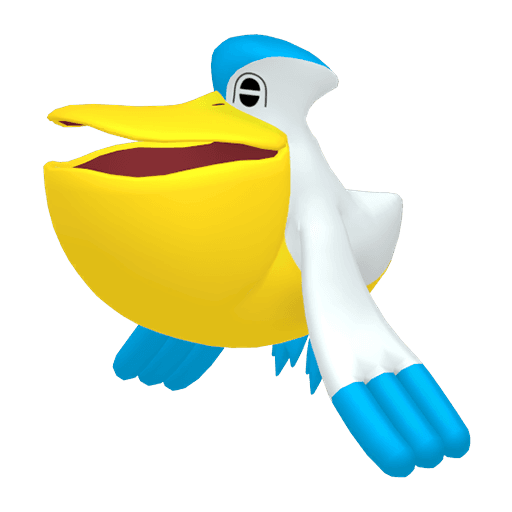
The setters: Politoed is bulkier and better at coming back multiple times in singles to renew rain. Pelipper is the dominant doubles pick — Flying typing immunizes it to the Earthquake its own partner Swampert often uses, and it brings real offensive utility in Hurricane (100% accuracy in rain) and Tailwind for stacked speed control. A Pelipper that opens with Tailwind and follows up with Hurricane is doing a lot more than just setting weather.
Swift Swim sweepers: Swampert with Swampertite is the archetype. After Mega Evolution, its ability flips from Torrent to Swift Swim — critically, the Speed doubling only applies after evolution, so don't forget to actually Mega Evolve. Its Earthquake hits allies in doubles, but Pelipper is Flying-type and immune, which is exactly why those two are a natural pair. Araquanid runs Water Bubble, which doubles Water-move damage on top of rain's ×1.5 — Liquidation at base 85 becomes 85 × 1.5 (rain) × 2 (Water Bubble) = effective 255 power before STAB. In doubles, that's targeted removal.
Defensive glue: Toxapex doesn't benefit from rain directly, but Fire moves dropping to half-power removes one of its few real checks — it sits on rain teams because the field conditions suit it, not because of any rain synergy. Gastrodon with Storm Drain absorbs opponent Water moves entirely and raises its own Sp. Atk — in a rain mirror, it shuts down the opposing Water attackers before they fire a single shot.
How to use it
Singles: Lead with the setter, then pivot to your Swift Swim attacker. Five turns is a budget — don't spend it switching back to the setter unless you genuinely need to renew. If the setter gets knocked out, Rain Dance is the backup, but it costs a turn and your opponent can predict it and punish the setup with a free switch or attack. Keep the setter alive.
Doubles: Setter and sweeper go out together. Classic turn one: Pelipper uses Tailwind, Swampert Mega Evolves as a free action and immediately fires Waterfall or Earthquake. By end of turn one, you have rain up, Tailwind up, and Mega Swampert already hitting at doubled Speed — the opponent often hasn't landed a single significant attack yet. That's the pressure rain teams generate.
When the rain timer gets low, actively bring the setter back in to reset rather than waiting for it to expire. The turn weather drops to zero, your opponent has information and initiative; don't give them a free window.
Tips & strategy
Damp Rock tradeoffs: Eight turns of rain means fewer rotations back to the setter. The cost is the item slot — no Rocky Helmet for chip on physical attackers, no Eject Button for momentum plays. On Pelipper, Damp Rock is the more common choice because the extra turns reduce a structural vulnerability (setter getting sniped too early), but it depends on what physical threats you expect.
Thunder is serious: 100% accuracy in rain, 30% paralysis chance. In Champions, the full-stop rate is 12.5% (not 25% like older games), but Speed stays halved. In practice, Thunder in rain is used more for its guaranteed accuracy and paralysis pressure than for the stop rate — it still threatens the slow and is a meaningful upgrade over Thunderbolt for any special attacker that can learn both.
Weather wars: Any opposing weather setter — Drought, Sand Stream, Snow Warning — cancels rain the moment they switch in, and every Water move you threw before that is suddenly at normal power. In doubles, if the opponent leads with a weather setter, getting your Drizzle user on field becomes priority. This is why the setter's bulk actually matters: a Pelipper that eats one hit and survives to set rain is doing its job; one that gets one-shot before it can act is not.
Common mistake autopsy: The most frequent beginner error is sending out Swampert without Mega Evolving, assuming Swift Swim is already active. It isn't — the ability is Torrent until the Mega Evolution action is selected, and at base 60 Speed it will be outsped and KO'd before it touches anything. A related mistake is saving the Omni Ring's Mega Evolution slot for a different team member, leaving Swampert to run without Swift Swim entirely — a 60 Speed wallbreaker in a rain team is just a slow wallbreaker.
Hard counters: Cloud Nine (Golduck and a few others) suppresses all weather effects while the user is on the field — no Water boost, no Thunder accuracy, no Swift Swim Speed doubling, none of it. It doesn't replace the weather, it just turns it off. Against a Cloud Nine user, rain teams revert to being a normal team with a useless passive ability. The other reliable counter is simply removing the setter before it can renew — rain teams without rain are structurally weaker than teams built without weather reliance at all.