
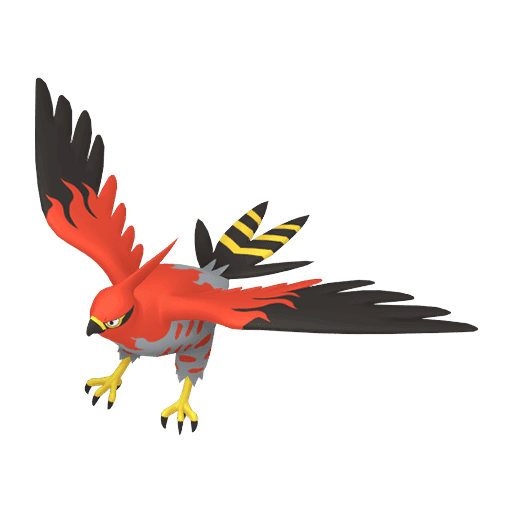
What it does
Gale Wings bumps every Flying-type move to +1 priority when the user is at full HP. Flying moves normally sit at priority 0 — after the boost they land in the same tier as Extreme Speed, ahead of every ordinary attack in the game, but below Fake Out's +3.
The numbers that make it matter. Tailwind doubles the Speed of your entire side for four turns (not counting the turn it's set). Take Garchomp as a partner: a Jolly 32 Stat Points build hits roughly 150 Speed at Lv50. Under Tailwind that's an effective 300 — enough to outrun Flutter Mane at ~187 Speed. Kingambit with Adamant and no Speed investment sits around 85; under Tailwind it reaches 170, moving before virtually every unboosted opponent. The difference isn't marginal — it's the line between trading hits and clicking first every single turn.
Priority Brave Bird matters too: with Adamant and 32 Attack Stat Points, Talonflame hits hard under Sharp Beak's boost, and that attack lands before all normal moves regardless of the target's Speed. Revenge killing becomes trivial.
The hard constraint. One point of HP lost — from a hit, recoil, weather, entry hazards, status chip, anything — and Gale Wings turns off immediately. There is no recovery in a Champions match that restores Talonflame to full HP mid-battle, so once the ability deactivates, it's gone for the game. At that point Talonflame is a decent but unremarkable attacker.
Who runs it
The only competitive Gale Wings user is Talonflame.
Talonflame — Speed-control core Standard build: Jolly, 32 Attack / 32 Speed Stat Points, Focus Sash or Sharp Beak. Moveset: Tailwind + Quick Guard + Brave Bird + Flare Blitz (or situationally Will-O-Wisp). It wants this ability because its base 126 Speed is already elite — Gale Wings turns that into a guarantee: even a Choice Scarf user can't move before the Tailwind lands.
Why only Talonflame? Gale Wings needs Flying-type tools worth prioritizing AND the Speed to act first with non-Flying moves like Quick Guard. Talonflame's toolkit — Tailwind for Speed control, Quick Guard to block opposing priority, Brave Bird and Flare Blitz for offense — is uniquely complete. No other Flying-type currently combines all three layers.
Doubles partners that justify the Tailwind:
- Garchomp: High Attack and solid base Speed that becomes dominant under Tailwind. Earthquake in doubles punishes grouped opponents; the Speed doubling pushes it past opponents it couldn't otherwise race.
- Kingambit: Low Speed, massive Attack, Supreme Overlord snowball potential. Without Tailwind, it moves last and dies before acting. With it, 170 effective Speed turns it into a first-moving guillotine.
- Sneasler: Already fast, but Tailwind removes any Speed trade risk and lets it click its powerful attacking moves without calculating if it wins the Speed tie.
How to use it
Doubles — the standard pattern:
Turn 1: Talonflame uses priority Tailwind — it moves before anyone regardless of Speed or items. The partner either uses Protect to survive turn 1, or uses Fake Out to flinch one opposing Pokémon and deny them their action. Tailwind is up before any response.
Turn 2: Speed is doubled. Now the decision tree opens. If Talonflame is still at full HP, priority Quick Guard can block opposing priority moves this turn. If a KO is available, priority Brave Bird finishes a weakened target. The partner attacks freely into a 2× Speed advantage.
Turns 3–4: Tailwind's effective window. By now Talonflame is often below full HP from recoil or chip — Gale Wings is off. The call here: pivot Talonflame out to preserve it as a pivot or late-game resource, rather than leaving it as a slow attacker burning turns your partner needs.
Singles — the key difference:
Tailwind in singles buffs only your own Pokémon and lasts three effective turns after the setup turn. The play pattern shifts: use priority Tailwind to establish Speed control, immediately switch to a high-damage attacker, then bring Talonflame back later for priority Brave Bird on a weakened target. The core read: is the opponent slow and bulky (set Tailwind and pivot) or fast and frail (priority Brave Bird to deny their action)?
Quick Guard timing in doubles: It's not a Flying-type move so Gale Wings doesn't boost it — but Talonflame's native Speed is high enough that it still outruns most opposing priority outside the +3 tier. If the opponent leads with a Fake Out user, turn 1 Quick Guard instead of Tailwind: block the disruption first, set Tailwind safely on turn 2.
Tips & strategy
Hazard removal isn't optional — it's pre-requisite. Stealth Rock strips 25% HP on entry and kills Gale Wings before Talonflame acts. Every Talonflame team needs a Rapid Spin or Defog user, or a partner that removes hazards before Talonflame comes in. Without this, Gale Wings is unreliable from match start.
[[widget:turn-order]] helps verify whether Tailwind's Speed doubling actually flips the turn order against a specific opponent, particularly when comparing close Speed values.
Common mistake autopsy — "I'll click Brave Bird first." The logic: deal priority damage before setting Tailwind, secure the KO. The result: Brave Bird's 1/3 recoil (roughly 33% of max HP) drops Talonflame below full HP that same turn. Gale Wings goes offline. The next Tailwind has zero priority. The opponent moves first. The entire Speed-control plan collapses because of one click. The fix: Tailwind first, always — unless a specific target is about to win the game and must be removed immediately, in which case you consciously accept losing the priority Tailwind as a trade-off.
What actually beats it:
- Stealth Rock — the strongest soft counter; forces Talonflame teams to commit a slot to hazard removal
- Fake Out — priority +3, moves before Gale Wings's +1, flinches Talonflame turn 1 and denies the Tailwind entirely
- Prankster users — Thunder Wave, Taunt, or Tailwind from their own side all operate at +1 from the item, matching or racing Gale Wings
- Rock-type attacks — Talonflame's 4× Rock weakness means Rock Slide in doubles threatens both targets and near-guarantees a drop below full HP even if not a KO
The Will-O-Wisp trap. Some builds slot Will-O-Wisp to cripple physical attackers. The subtle problem: Talonflame takes zero damage from using it, but if it gets hit by anything in the turns following, Gale Wings is gone before the burn even pays off. Worse, in doubles misfire risk exists. The slot is nearly always better spent on Flare Blitz for coverage or Quick Guard for team protection. Will-O-Wisp is a bait that makes the build look flexible while quietly undermining its primary function.