
Loading...
Loading...
Damage multipliers this Pokemon takes from each attacking type (based on the current form).
Damage multipliers of this Pokemon's same-type (STAB) moves against each defending type.
Based on real ladder matchup statistics and expert community assessments (data snapshot 2026-08)

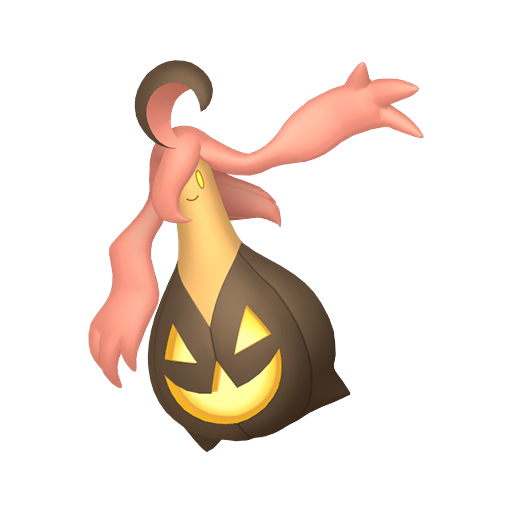
Gourgeist-Super shows a 0% usage rate in Pokemon Champions singles, failing to register in the rankings. Its Ghost/Grass typing immunizes Normal and Fighting while taking super-effective damage from Fire, Ice, Flying, Ghost, and Dark. The base stat spread leans physical (122 Def) with middling 75 SpD and 84 Spe, falling just short of the common 85 benchmark. Trick Room, Will-O-Wisp, Power Whip, Explosion, and Poltergeist dominate the move pool, with Leftovers at 44.7% and Frisk at 55.3%. Without access to Mega evolution in this format and against an unfamiliar opponent pool, it lacks the raw power and priority needed to carve out a reliable role.
Gourgeist-Super holds a 0.07% usage rate in Pokemon Champions doubles, sitting at rank 202. Trick Room leads the move pool at 20.4%, followed by Poltergeist at 18.5% and Trick-or-Treat at 17.7%, with these three together covering a majority of selections. Sitrus Berry (32.2%), Colbur Berry (18.2%), and Yache Berry (10%) are the most common items, while Frisk reaches 85.2% as the near-default ability. Its top partner is Kingambit at 11.4%.
Playstyle:Gourgeist-Super operates primarily as a Trick Room support piece. The 122 base Defense paired with the Relaxed 31/3/32/0/0/0 spread (23.2%) delivers physical bulk, while Frisk at 85.2% lets it identify opposing items on entry and dictate the flow from there. Trick-or-Treat at 17.7% and Will-O-Wisp at 4.1% handle the weakening role, with Poltergeist at 18.5% supplying offense for the minority. Sitrus Berry (32.2%) covers sustain, while Colbur Berry (18.2%) and Yache Berry (10%) answer Dark and Ice coverage respectively.

Gourgeist-Small registers a 0% usage rate in singles with no rank, effectively absent from the ranked ladder. Its stat spread leans toward bulk but its offensive profile is too shallow to threaten the standard defensive cores. The Ghost-Grass typing blocks Normal and Fighting and condenses weaknesses to Fire, Ice, Flying, Ghost, and Dark, yet no STAB combination provides enough pressure to anchor a singles build. The data shows the mon simply never established a foothold in the format.
Doubles ranked usage sits at 0%, with only a 0.07% share in the all-usage sample, placing Gourgeist-Small firmly on the fringe. Its move set revolves around Trick-or-Treat, Poltergeist, Will-O-Wisp, Trick, Foul Play, Power Whip, and Ally Switch, a utility-focused package that neither pressures through STAB output nor anchors a defensive core. Frisk at 77.4% and Choice Scarf at 65.5% define a role built on first-turn disruption rather than sustained damage. Teammates cluster around Whimsicott, Houndoom-Mega, Tyranitar-Mega, Ninetales, and Garchomp, other speed-reliant or status-heavy picks, which suggests the pumpkin fits only as a disruption cog inside specific archetypes rather than a standalone core.

Gourgeist posts a 0% usage rate in the standard single battle format, with an overall presence of just 0.08% and a rank outside the top 201. A 122 base Defense stat plus Ghost's immunity to Normal and Fighting invites a defensive shell, yet its 58 Special Attack and 84 Speed are too thin to anchor any offensive role the format actually demands.
Playstyle:The dominant shell pairs Choice Scarf at 62.9% with Insomnia at 69.5%. The Impish 32/0/2/0/32/0 spread pours EVs into both defenses and runs Will-O-Wisp, Power Whip and Destiny Bond as the core mix, with Destiny Bond at 16.7% serving as the dedicated revenge tool. Light Clay appears in 10.5% of sets to back the 4.5% Light Screen pick, while Trick Room at 3.1% is a fringe choice rather than a real option.
The doubles format records the same 0% usage rate with an overall share of 0.04%, placing Gourgeist in the deep fringe of the metagame. The 122 Defense and full immunities to Normal and Fighting still fail to convert into board control, since the 58 Special Attack and 84 Speed cap how much damage it can put on a double target without external setup.
Playstyle:Doubles runs Frisk at 82.4% with Choice Scarf at 32% as the leading shell. The move spread is far more diversified: Trick-or-Treat at 15.5%, Poltergeist at 11.8% and Trick Room at 11.5% head the list, while Will-O-Wisp at 10.6% and Power Whip at 9.5% supply damage and status pressure, and Ally Switch at 5.3% handles doubles-only positioning. The 15.5% Trick-or-Treat paired with 11.8% Poltergeist is the mechanism that lets Gourgeist layer extra type coverage on a target, and Trick Room at 11.5% marries its slow offensive profile into a space team.

Single-format usage sits at 0 with no rank this month, drawn from just 16 recorded battles. The Ghost and Grass typing grants immunities to Normal and Fighting while folding badly to Fire, Ice, Flying, Ghost, and Dark hits, and the special bulk takes on Water and Psychic pressure adequately. The role skews heavily support-side, and the lacking speed and damage output leave it without a clear answer to the format's core threats, which is why it barely appears in singles play.
Doubles usage also reads 0, yet 408 effective battles are over 25 times the singles count, which points to a real presence in the format. Poltergeist anchors at 14.3% as the STAB option, Trick Room shows up at 14.5% as a tempo pivot, and Trick-or-Treat at 15.3% drags opposing targets into compound damage alongside partners. Choice Scarf at 27.9% indicates a workable presence outside Trick Room, while Focus Sash at 8.8% and Lum Berry at 8.3% each fund a different plan: priority finishing and status cure respectively. Frisk at 72.3% explains why players want to read opposing items on turn one to plan around them.
Playstyle:Gourgeist-Large typically slots into Trick Room lineups as a mid-speed support piece. Poltergeist handles the Ghost-type physical damage, and Spell Tag at 8.8% reinforces the read-driven plan: punish opponents switching into Ghost or Grass weaknesses. Trick-or-Treat turns ally hits into more reliable compound coverage, pairing naturally with hard hitters like Mawile-Mega, Tyranitar-Mega, and Reuniclus to chain pressure. Choice Scarf builds keep it relevant when Trick Room fails to set up, but 84 base Speed means that outside TR the unit struggles to move before Fire, Ice, and Flying threats, which is what keeps it locked into the niche tier.